


Headquarters Tel: 010-62932100
Sales Hotline: 010-62927938
Headquarters Address: 10th Floor, Building A, Huizhi Building, No. 9 Xueqing Road, Haidian District, Beijing
Email: info@syn-tron.com


In recent years, with rising aesthetic awareness and improved living standards, high-grade yarn-dyed products have become increasingly popular. Besides pure silk, chemical filament, rayon, blended yarn, and cotton yarn can also be woven using dyed yarn. This has led to the wide application of package dyeing in the yarn-dyed textile industry. Before package dyeing, purchased grey yarn is generally wound into soft packages suitable for dyeing for subsequent processes, resulting in growing demand for precision soft winding machines.
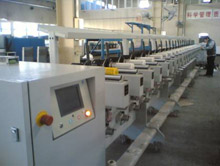
Most domestic soft winding machines adopt centralized single-spindle drive systems. Winding, yarn guiding, overfeed and other motions are traditionally realized via mechanical gears and cams, making it difficult to adjust the machine for different yarn types and processes. Yarn guiding relies on grooved drums or rotating vanes, which often cause damage to high-end yarns. Meanwhile, due to mechanical transmission structures, winding speeds are relatively low. By contrast, advanced foreign soft winding machines have adopted fully digital winding systems based on electronic gears and electronic cams, featuring independent single-spindle drive. Winding, traverse guiding, yarn overfeed, and tension compensation are all controlled by individual motors. Motion relationships among motors are configured via parameters, flexibly satisfying the winding requirements of various yarn characteristics. Traverse guiding uses a yarn guide (commonly known as a “rabbit head”), which causes minimal yarn damage and is especially suitable for high-grade dyed yarns. With no direct mechanical connection between motors and high-speed precision motion control algorithms, high-speed precision cross winding is easily achieved. Winding speeds are much higher than mechanical soft winding machines, greatly improving efficiency.
Beijing HollySys Motor Technology Co., Ltd., in cooperation with leading domestic textile machinery groups, drawing on years of experience in servo and motion control, has successfully developed China’s first fully proprietary high-speed precision soft winding machine electrical control system. The solution offers excellent cost-performance, greatly enhances the automation level of domestic soft winding machines, and its main technical indicators reach the level of comparable foreign equipment.
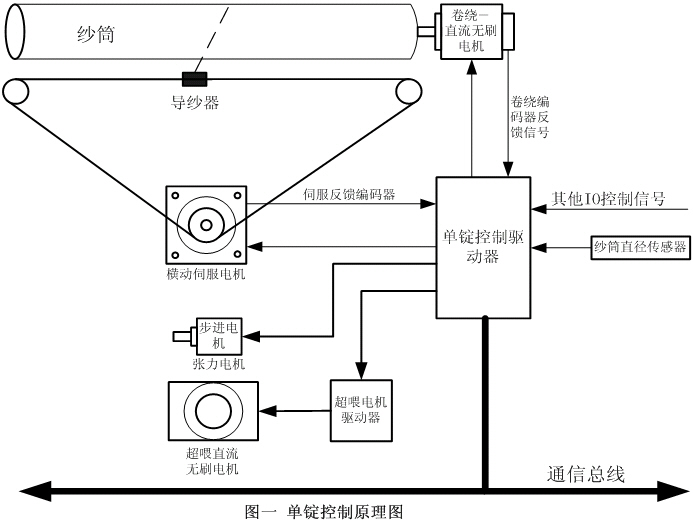
Taking single-spindle control as an example, the control principle is shown in Figure 1. A wire wheel is mounted on the traverse motor shaft; its forward and reverse rotation drives the yarn guide attached to the steel wire to move left and right, realizing traverse motion. The winding motor directly drives the package rotation to achieve yarn winding. The combination of traverse and winding motions forms a helical yarn pattern on the package surface. The tension compensation motor and overfeed motor are mainly used to control tension during winding.
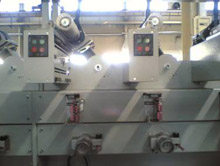
In this solution, the traverse guiding motor uses a uniquely designed ultra-low-inertia servo motor. The winding and overfeed motors use custom-designed high-speed brushless DC motors, and the tension motor uses a standard stepper motor. The “Single-Spindle Controller” is a dedicated drive and control system developed by HollySys, based on its fully digital permanent magnet AC servo driver, integrating high-speed electronic yarn guide motion control algorithms, winding brushless motor speed control, and yarn tension control strategies. The system features a simple structure and complete functions. Process parameters – including package geometry (full diameter, edge trimming width), winding linear speed, winding ratio, traverse length, differential amplitude, differential period, and differential cam curve for hard-edge elimination – can be easily set by adjusting internal memory parameters via keypad or communication. Equipped with RS232, RS485, and CAN bus interfaces, multi-spindle networked control is readily achieved, realizing fully flexible digital winding. Main technical parameters are as follows:
Traverse Servo Motor Control Overview
To ensure good dyeing performance, yarn must cross three-dimensionally at any diameter from the start to full package, without parallel layers or overlapping. This requires precise control of the winding ratio — defined as the number of package rotations per traverse cycle. There are three cross-winding types: random winding (grooved drum), constant winding-ratio precision winding, and digital layered winding. This solution implements constant winding-ratio precision cross winding and digital layered winding. To achieve precision cross winding, the Single-Spindle Controller calculates real-time winding motor speed by collecting encoder feedback. Based on precision winding requirements, a proprietary numerical control algorithm generates the speed command for the traverse servo motor, maintaining a precise ratio between traverse and winding speeds to form a stable helical winding pattern. Precision electronic gears and electronic cams replace mechanical gears and cams, enabling high-precision winding. To achieve high-speed performance, the traverse motor must reverse rapidly, requiring a high torque-to-inertia ratio. The traverse servo motor is specially optimized for minimal rotor inertia. The servo drive algorithm adopts enhanced PID combined with fuzzy control to ensure fast reversal without overshoot. To eliminate hard edges caused by motor reversal, a differential cam motion algorithm is embedded in the controller, which periodically shifts the traverse reversal point. Different differential cam curves, periods, and amplitudes can be selected for different yarn characteristics. In addition to differential electronic cam algorithms, this solution uniquely implements minimum reversal arc-length control. Using high-speed DSP computing, the system continuously adjusts the cam profile between the traverse motor and winding motor, minimizing reversal arc length at any speed or package diameter, and maximally eliminating hard edges.
Theoretically, winding linear speed changes with package radius, causing tension fluctuations that affect package formation and yarn physical properties. Excessively high tension in outer layers may squeeze inner layers, causing edge bulging. Large tension variations also lead to inconsistent yarn elongation. Therefore, maintaining relatively stable linear speed is critical to control tension fluctuation, in addition to constant package pressure.
During precision winding, yarn tension directly affects package density, dyeing uniformity, and breakage rate. Tension for dyeing packages should be moderate to achieve soft packages. This solution includes a tension attenuation device using a stepper-motor-driven tension lever. During acceleration, the tension lever angle is adjusted to control gate clamping force and maintain constant tension. According to the “tight inner, loose outer” process requirement, tension can be automatically adjusted based on package radius — higher tension for small diameters and lower tension for large diameters.
In precision winding, if package winding speed exceeds yarn supply speed, tension increases, causing poor package formation and higher breakage. This solution adopts overfeed control: yarn delivery speed is slightly higher than winding speed, converting “hard pulling” into gentle winding, reducing breaks and producing ideal soft packages. Overfeed ratio is typically controlled between 1.02 and 1.06 (single wrap).
Precision winding and yarn spinning machines are key equipment for improving textile quality. The high-speed precision digital winding solution masters the core KNOW-HOW of high-speed yarn winding. Using permanent magnet motor drive technology, the system consumes significantly less energy than traditional inverter-driven machines. With flexible digital control, it is ideal for high-grade textile production involving multi-type, small-batch packages, delivering strong social and economic benefits. This innovative solution developed by HollySys integrates electronic control, digital servo motors and drives, precision motion control, and computer network communication — a typical high-tech mechatronic control system and a successful example of digital technology upgrading traditional industry.

Headquarters Tel: 010-62932100
Sales Hotline: 010-62927938
Headquarters Address: 10th Floor, Building A, Huizhi Building, No. 9 Xueqing Road, Haidian District, Beijing
Email: info@syn-tron.com
Servo Motor, Stepper Motor, Servo Driver, Stepper Driver, Hub Motor
Copyright: BEIJING SYNTRON MOTION CONTROL TECHNOLOGY CO.,LTD.Beijing ICP No. 11028021-1Sitemap

